
 No, this is not some postmodern or post-structuralist article, all about how reality is an construction of whatever. It is rather an essay on how we all subconsciously construct our own internal image of reality. An image we rarely think of, but which form the basis of all most all our decisions.
In modern day we have a large variety of more or less scientifically validated sources of knowledge about the world around us - both nature and society. Everything from opinion polls to figure out what a population thinks, to double blind tests to see if a medical procedure has the desired effect, to a large amount of quantitative and qualitative research on a huge variety of issues.
However not many people go to scientific peer-review journals, statistical bureaus, and other sources of that kind to actively build a image of the world they inhabit. Rather the image builds itself as a result of a cumulative array of impressions and single pieces of information.
When the human brain developed there was no peer-review journals, and there were no anonymous opinion polls. Basically, there was only one way of getting information of the world - your own personal experiences, or information given to you from another single individual. Information was basically anecdotal, and little else. Therefore it is nothing but natural that our brain is basically constructed to create a mental map of the world based by the accumulative knowledge that comes from the sum of all these individual pieces of information. This has obviously served us well over the milennia, but it is important to also know the limitations of this approach, now that all humans increasingly are subject to ever more complex and abstract decision-making.
I am a firm believer of democracy. For democracy to work according to its intentions, it is however important that people make decisions on a basis that is firm and grounded in knowledge. Most of the time I believe the majority of the population is on the right track, however many political processes are diverted by minor issues being blown out of proportion, while big issues are subject to little debate. There lies huge political power in deciding what issues will be at the forefront of political debate. (As an example I can mention how little attention is given to the politics of the workplace even though it is the place where people spend halve their waking hours on a normal day.) You can’t fool all the people all the time, but when you fool people a sufficient number of times, you may succeed in constructing in them an image of reality that reflects your interests rather than an image that forms a more or less objective model - not least to say their interests.
I will now give a couple of examples from quite different areas of society.
Immigration/Islam: Since before 9/11 2001, but since then intensified, there has been groups that have been trying to vilify Muslim minorities. This is not new. From colonial racism, through 30’s fascism, general aggression towards immigrants during the 70s and 80s, until the present demonizing of Muslims, forms of xenophobia has run like a continuous stream through parts of newer European history. Often this has been accompanied with complex conspiracy theories. With antisemitic sentiment came ideas from “the Protocols of the Elders of Zion”, and in Nazi Germany the ideas of the “Judeo-Bolshevism “gave an excuse to round up both Jews and leftists all based on the same conspiracy theory. We see the same with the modern anti-Muslim sentiment. Some extreme milieus today construct a conspiracy theory claiming that European leaders (and/or again the left)are in a conspiracy with the Muslim world wherein large immigration combine with an enormous birthrate will create a Muslim majority in Europe within a few decades. This will be a starting point of a new “world califat” where non-Muslims will be demoted to the lower social status of “dhimmi”.
The real truth about Muslims you see when you do research and conduct proper surveys, is slightly less threatening. The huge majority of Muslims are just like you and me - they want to live in peace, in a free and democratic society. There are some statistical differences in opinion between Muslims and e.g. Norwegians, of course, but they are small and none support the conspiracy theories promoted by European far-right nationalists.
Not very many people believe the extreme versions of these theories, but quite a few take some sort of perceived “middle” position - perhaps partially fuelled by ideas of “no smoke without fire”, but also numerous media stories of Muslim terrorist actions which aggregate into a conscious or sub-conscious understanding of Muslims as a group as suspicious.
Pseudoscience/homeopathy: This summer I was engaged in a lengthy debate about homeopath, which you can see from these links (google translate from Norwegian):
http://translate.google.com/translate?js=n&prev=_t&hl=en&ie=UTF-8&layout...
http://translate.google.com/translate?js=n&prev=_t&hl=en&ie=UTF-8&layout...
http://translate.google.com/translate?hl=en&sl=auto&tl=en&u=http%3A%2F%2...
Homeopathy - like most of alternative medicine, has undergone rigorous scientific testing through many years, and like most alternative medicine, has been shown to have no medicinal effect whatsoever. For a more thorough analysis on current knowledge on the topic, see e.g. Ernst&Singh - Trick or Treatment at http://www.trickortreatment.com.
Despite this a lot of people believe in the effect of homeopathy, perhaps also here from some idea that there “is more between heaven and earth”, but also many individual stories told in glossy magazines, and by acquaintances, of people feeling better after taking these medicines. Again - an accumulation of individual anecdotal evidence - consciously or subconsciously - create a mental image of reality. This is a mental shield a few scientific papers have problems penetrating. Should a person happen to hear about some scientific result, it will perhaps carry a little more weight than a single anecdote, but it will not carry a weight proportional to the information it really gives us in this respect, not to mention the difference between scientific studies of different quality, and a single study and a high quality meta study. When mass media report on science, they rarely differentiate between the quality of the research in a way that makes it possible for people to evaluate the quality of the research, even if they should be prone to such critical thinking.
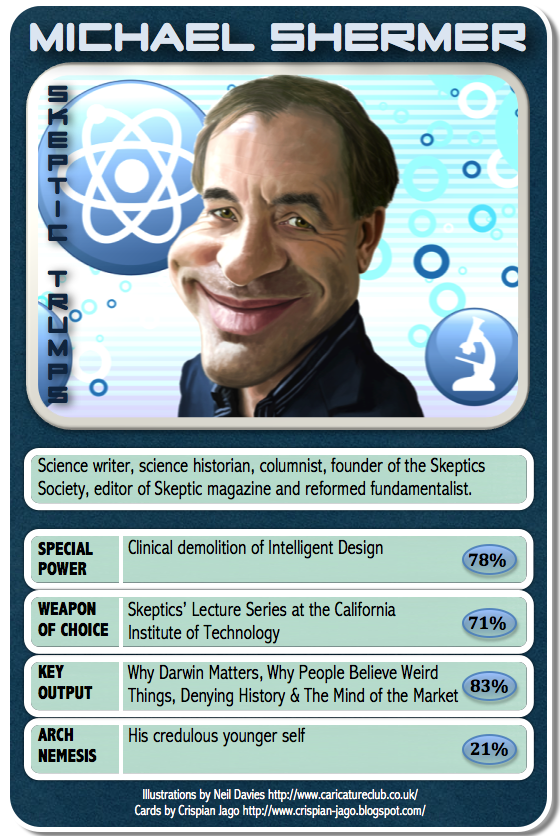 This anecdotal accumulation is one general bias in human thinking, that i believe has been somewhat undercommunicated in the public and scientific debate, and it is one that gives mass media tremendous power, as they represent many of all these aggregated anecdotal stories that people pick up on. There are of course also other biases. One such is the confirmation bias Michael Shermer points out in this article. We are a lot quicker to believe things we hear that fit with our preconceived ideas, than things that do not. It is easy to see how this can work together with anecdotal accumulation to create a very skewed world view. Another worrying tendency that has been brought up is that modern web-based forms of media and communication, makes it much easier for us to exclude the information we don’t want, and only read news that coincide with our preconceived ideas. Different forms of communication change so rapidly, and I believe there are to many different contradicting tendencies in web-based communication to conclude on this, but it is obviously a tendency we should watch, as it is not new to the digital age.
The same Shermer gives a TED-talk on self deception here, where he points out our tendency to see patterns and suspect mischief where there is none. Evolutionarily we are pattern-seeking animals, and this of course can also lead us into seeing patterns where there are none. In many cases it’s better to see a pattern too many, than to see one to little, but it does open the path into our minds for different types of conspiracy theories.
A fourth thought-error humans are prone to is dualism. We have a tendency to divide all questions into two alternatives. (e.g. Muslims are ether terrorists or just like the rest of us, Homeopathy works or does not) This may not be such a big problem, at least on all issues, but when it is coupled with the old Socratian idea of “the golden middle way”, many people are prone to thinking that the truth lies, if not in the middle, at lest somewhere in between. As we know, in many cases, this is not so.
Together all these biases and errors of thought can lead people astray. - I have mentioned Conspiracy-theories around Muslims - historically (and even currently in - ironically - some Muslim countries) we have seen similar conspiracy theories about Jews. These two “political” thought-errors most often occur on the far right of the political spectrum, but the left also has got its loonies, f.eks. the large group of “truthers” who believe the Bush administration was behind the 9/11 attacks. All that said - many conspiracy theorists can be hard to place on a left-right political scale. Alternative medicine is of course also only one example from the “alternative” movement of how the mind is led askew. Crop circles made by aliens, auras and ideas about a whole range of “energies” (from people who obviously do not know what the word “energy” means) are others. The examples of such “errors of the mind” are many, and I may have mentioned a few extremes here as an illustration. But I think there is reason to believe, that most such errors we make are somewhat smaller in magnitude. We will probably never be completely rid of them either, but I believe it is possible to diminish their effect by being aware of them.
The beforementioned Shermer has written extensivley on errors of the human mind. I can recommend "How thinking goes wrong" for further reading at http://www.positiveatheism.org/writ/sherm3.htm


Skriv ny kommentar